
Hunting periods published by Québec.ca
Official tables below — zones, gear and dates.
Wikipedia
Ouaouaron
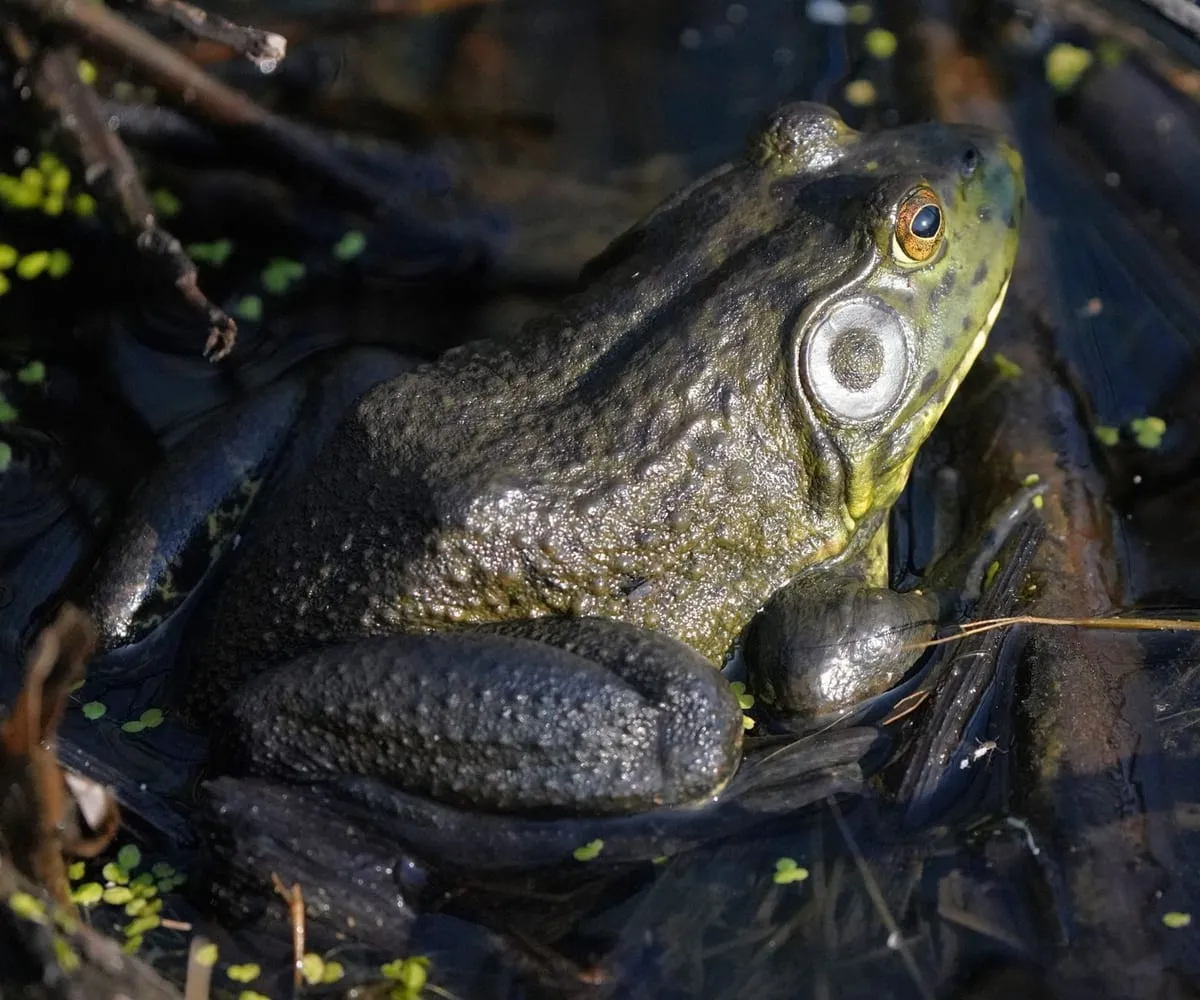
The American bullfrog (Lithobates catesbeianus), often simply known as the bullfrog in Canada and the United States, is a species of large frog in the family Ranidae (true frogs). The species is native to eastern North America. It typically inhabits large permanent water bodies such as swamps, ponds, and lakes. The bullfrog can also be found in manmade habitats such as pools, koi ponds, canals, ditches, reservoirs and culverts. The bullfrog gets its common name from the sound the male makes during the breeding season, which sounds similar to a bull bellowing. It is a generalist carnivore, consuming a wide variety of prey. In turn, it is eaten by predators such as alligators, snakes, and birds. The bullfrog is large and is commonly eaten by humans throughout its range, especially in the southern United States where it is plentiful. Its use as a food source has led to the bullfrog being introduced outside of its native range. The bullfrog has been introduced in more than 40 countries and many continents including the Western United States, the Caribbean, South America, Western Europe, Belgium, Italy, Spain, Greece, China, Japan, South Korea, Malaysia, Southeast Asia, and more. In these places it is considered an invasive species due to its voracious appetite and the large number of eggs it produces, which has a negative effect on native amphibians, certain insects and other fauna. The bullfrog is very skittish, which can make its capture difficult, and thus it often becomes established. Other than for food, the bullfrog is also used for dissection in science classes. Albino bullfrogs are sometimes kept as pets, and bullfrog tadpoles are often sold at ponds or fish stores.
Description
The dorsal (upper) surface of the bullfrog has an olive-green background color, either plain or with mottling and banding of grayish brown. The ventral (under) surface is off-white blotched with yellow or gray. Often, a marked contrast in color is seen between the green upper lip and the pale lower lip. The teeth are tiny and are useful only in grasping. The eye is prominent with a brown iris and a horizontal, almond-shaped pupil. The tympanum (eardrum) is easily seen just behind the eye, and a dorsolateral fold of skin encloses it. The limbs are blotched or banded with gray. The fore legs are short and sturdy, and the hind legs are long. The front toes are not webbed, but the back toes have webbing between the digits with the exception of the fourth toe, which is unwebbed. The bullfrog is sexually dimorphic, with males being smaller than females and having yellow throats. Males have tympana larger than their eyes, whereas the tympana in females are about the same size as the eyes. Bullfrogs measure about 3.6 to 6 in (9 to 15 cm) in snout–to–vent length. They grow fast in the first eight months of life, typically increasing in weight from 5 to 175 g (0.18 to 6.17 oz), and large, mature individuals can weigh up to 500 g (1.1 lb).
Text from Wikipedia — American bullfrog, revision 1371086283, CC BY-SA 4.0, retrieved 2026-09-04. Encyclopedic text reused under CC BY-SA 4.0. Sentences about hunting or regulation are removed: on this site, the rule comes from Québec.ca.
Other names
French
English
Former scientific names
Presence in Quebec
- Origin
- Indigène
- Occurrence
- Régulier
- Population status
- Toute l'année
- Certainty
- Confirmé
Conservation
Québec.ca
Official periods
Source: Québec.ca — tables reproduced as published (retrieved 2026-08-30).
Hunting
Leopard frog, green frog and bullfrog
| Zone where hunting is permitted | Gear | 2026 hunting season | 2027 hunting season |
|---|---|---|---|
| 1, 2, 3, 4, 5, 6, 7, 8, 9, 10, 11, 12, 13, 14, 15, 16, 18, 19 South, 20, 21, 26, 27, 28, 29 | Deadfall, barrier, stinger, dip net, pit, hook and hand | July 15 to November 15, 2026 | July 15 to November 15, 2027 |
Zones where hunting is permitted
Zone numbers listed in the tables above. Each links to the official zone map (PDF).
Regulations change. Always check Québec.ca before hunting or trapping.
Where this data comes from
This species is listed in an official government dataset. The identification and status shown in the data sheet are reproduced from it.
Source: List of Quebec’s vertebrate wildlife (LFVQ) — Ministère de l’Environnement, de la Lutte contre les changements climatiques, de la Faune et des Parcs. File LFVQ_25_03_2026.csv, retrieved 2026-08-30 · CC BY 4.0.
Measurements, habitat, diet and reproduction are not shown: no official source is attached to them yet.