
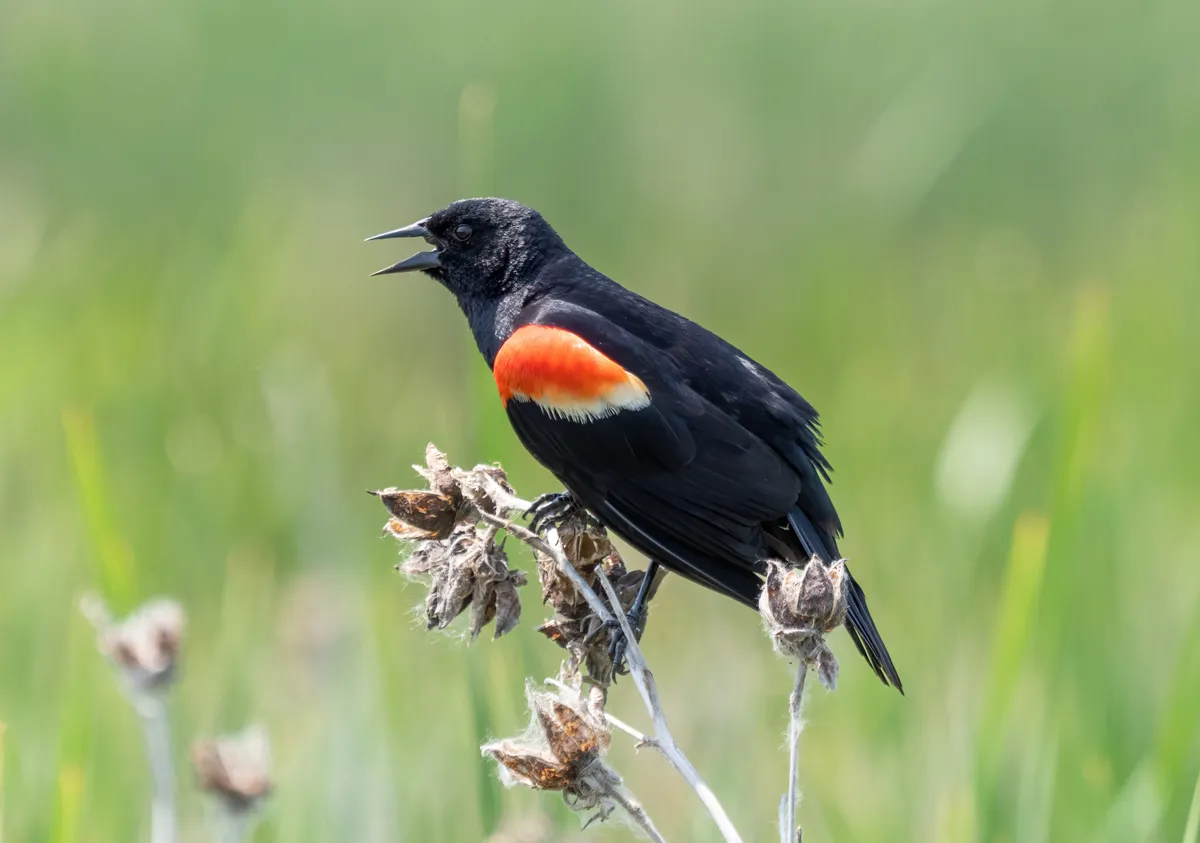
Carouge à épaulettes— species and hunting in Quebec
Agelaius phoeniceus
IcteridaeHunting periods published by Québec.ca
Official tables below — zones, gear and dates.
Wikipedia
Carouge à épaulettes
The red-winged blackbird (Agelaius phoeniceus) is a passerine bird of the family Icteridae found in most of North America and much of Central America. It breeds from Alaska and Newfoundland south to Florida, the Gulf of Mexico, Mexico, and Guatemala, with isolated populations in western El Salvador, northwestern Honduras, and northwestern Costa Rica. It may winter as far north as Pennsylvania and British Columbia, but northern populations are generally migratory, moving south to Mexico and the Southern United States. Claims have been made that it is the most abundant living land bird in North America, as bird-counting censuses of wintering red-winged blackbirds sometimes show that loose flocks can number in excess of a million birds per flock and the full number of breeding pairs across North and Central America may exceed 250 million in peak years. It also ranks among the best-studied wild bird species in the world. The red-winged blackbird is sexually dimorphic; the male is all black with a red shoulder and yellow wing bar, while the female is a nondescript dark brown. Seeds and insects make up the bulk of the red-winged blackbird's diet.
Description
The common name for the red-winged blackbird is taken from the mainly black adult male's distinctive red shoulder patches, or epaulets, which are visible when the bird is flying or displaying. At rest, the male also shows a pale yellow wingbar. The spots of males less than one year old, generally subordinate, are smaller and more orange than those of adults. The female is blackish-brown and paler below. The female is smaller than the male, at 17–18 cm (6.7–7.1 in) long and weighing 41.5 g (1.46 oz), against his length of 22–24 cm (8.7–9.4 in) and weight of 64 g (2.3 oz). The smallest females may weigh as little as 29 g (1.0 oz) whereas the largest males can weigh up to 82 g (2.9 oz). Each wing can range from 8.1–14.4 cm (3.2–5.7 in), the tail measures 6.1–10.9 cm (2.4–4.3 in), the culmen measures 1.3–3.2 cm (0.51–1.26 in) and the tarsus measures 2.1 cm (0.83 in). The upper parts of the female are brown, while the lower parts are covered by an intense white and dark veining; also presents a whitish superciliary list. According to Crawford (1977), females exhibit a salmon-pink stain on the shoulders and a light pink color on the face and below this when they are a year old, while older females show a stain usually more crimson on the shoulders and a darker pink hue on and under the face. Observations in females in captivity indicate that small amounts of yellow pigment are present on the shoulders of these after leaving the nest, that the concentration of the pigment increases with the first winter plumage after the change of the feathers and that the passage from yellow to orange generally takes place in the second summer with the acquisition of the second winter plumage, after which no further changes in feather color occur.
Text from Wikipedia — Red-winged blackbird, revision 1371574791, CC BY-SA 4.0, retrieved 2026-09-04. Encyclopedic text reused under CC BY-SA 4.0. Sentences about hunting or regulation are removed: on this site, the rule comes from Québec.ca.
Other names
French
English
Presence in Quebec
- Origin
- Indigène
- Occurrence
- Régulier
- Population status
- Reproducteur
- Certainty
- Confirmé
Conservation
Québec.ca
Official periods
Source: Québec.ca — tables reproduced as published (retrieved 2026-08-30).
Hunting
Red-winged blackbird, American crow, European starling, house sparrow, common grackle, brown-headed cowbird
| Zone where hunting is permitted | Gear | 2026-2027 hunting season | 2027-2028 hunting season |
|---|---|---|---|
| 1, 2, 3, 4, 5, 6, 7, 8, 9, 10, 11, 12, 13, 14, 15, 16, 17, 18,19 South, 20, 21, 22, 23, 24, 26, 27, 28, 29 | Firearms, air rifles, crossbow and bow The use of a crossbow is prohibited in zones 17, 22, 23 and 24. | July 1, 2026 to April 30, 2027 | July 1, 2027 to April 30, 2028 |
Zones where hunting is permitted
Zone numbers listed in the tables above. Each links to the official zone map (PDF).
Regulations change. Always check Québec.ca before hunting or trapping.
Where this data comes from
This species is listed in an official government dataset. The identification and status shown in the data sheet are reproduced from it.
Source: List of Quebec’s vertebrate wildlife (LFVQ) — Ministère de l’Environnement, de la Lutte contre les changements climatiques, de la Faune et des Parcs. File LFVQ_25_03_2026.csv, retrieved 2026-08-30 · CC BY 4.0.
Measurements, habitat, diet and reproduction are not shown: no official source is attached to them yet.