
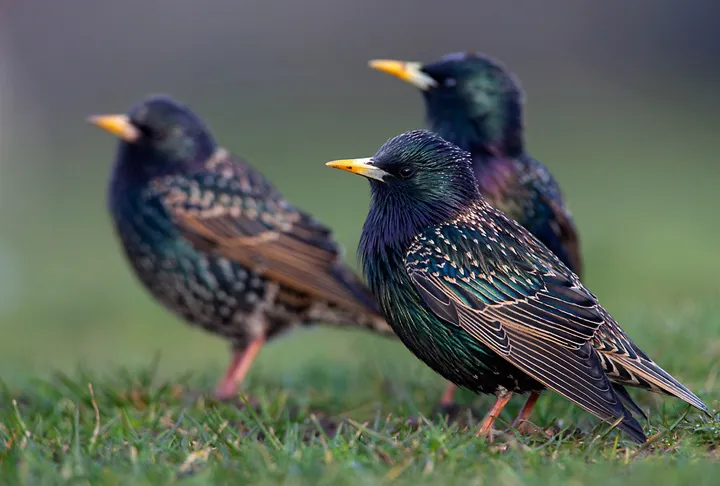
Étourneau sansonnet— species and hunting in Quebec
Sturnus vulgaris
SturnidaeHunting periods published by Québec.ca
Official tables below — zones, gear and dates.
Wikipedia
Étourneau sansonnet
The common starling (Sturnus vulgaris), also known simply as the starling in Great Britain and Ireland, and as the European starling in North America, is a medium-sized passerine bird in the starling family, Sturnidae. It is about 20 cm (8 in) long and has glossy black plumage with a metallic sheen, which is speckled with white at some times of the year. The legs are pink and the bill is black in winter and yellow in summer; young birds have browner plumage than the adults. Its gift for mimicry has been noted in literature including the Mabinogion and the works of Pliny the Elder and William Shakespeare. The common starling has about 12 subspecies breeding in open habitats across its native range in temperate Europe and across the Palearctic to western Mongolia, and it has been introduced as an invasive species to Australia, New Zealand, Canada, the United States, Mexico, Argentina, South Africa and Fiji. This bird is resident in western and southern Europe and southwestern Asia, while northeastern populations migrate south and west in the winter within the breeding range and also further south to Iberia and North Africa. The common starling builds an untidy nest in a natural or artificial cavity in which four or five glossy, pale blue eggs are laid. These take two weeks to hatch and the young remain in the nest for another three weeks. There are normally one or two breeding attempts each year. This species is omnivorous, taking a wide range of invertebrates, as well as seeds and fruit. Large flocks typical of this species can be beneficial to agriculture by controlling invertebrate pests; however, starlings can also be pests themselves when they feed on fruit and sprouting crops. Common starlings may also be a nuisance through the noise and mess caused by their large urban roosts. Introduced populations in particular have been subjected to a range of controls, including culling, but these have had limited success, except in preventing the colonisation of Western Australia. The species has declined in numbers in parts of northern and western Europe since the 1980s due to fewer grassland invertebrates being available as food for growing chicks. Despite this, its huge global population is not thought to be declining significantly, so the common starling is classified as being of least concern by the International Union for Conservation of Nature.
Description
The common starling is 19–23 cm (7.5–9.1 in) long, with a wingspan of 31–44 cm (12–17 in) and a weight of 58–101 g (2.0–3.6 oz). Among standard measurements, the wing chord is 11.8 to 13.8 cm (4.6 to 5.4 in), the tail is 5.8 to 6.8 cm (2.3 to 2.7 in), the culmen is 2.5 to 3.2 cm (0.98 to 1.26 in) and the tarsus is 2.7 to 3.2 cm (1.1 to 1.3 in). The plumage is iridescent black, glossed purple or green, and spangled with white, especially in winter. The underparts of adult male common starlings are less spotted than those of adult females at a given time of year.
Text from Wikipedia — Common starling, revision 1367387771, CC BY-SA 4.0, retrieved 2026-09-04. Encyclopedic text reused under CC BY-SA 4.0. Sentences about hunting or regulation are removed: on this site, the rule comes from Québec.ca.
Other names
French
English
Presence in Quebec
- Origin
- Exotique
- Occurrence
- Régulier
- Population status
- Toute l'année
- Certainty
- Confirmé
Conservation
Québec.ca
Official periods
Source: Québec.ca — tables reproduced as published (retrieved 2026-08-30).
Hunting
Red-winged blackbird, American crow, European starling, house sparrow, common grackle, brown-headed cowbird
| Zone where hunting is permitted | Gear | 2026-2027 hunting season | 2027-2028 hunting season |
|---|---|---|---|
| 1, 2, 3, 4, 5, 6, 7, 8, 9, 10, 11, 12, 13, 14, 15, 16, 17, 18,19 South, 20, 21, 22, 23, 24, 26, 27, 28, 29 | Firearms, air rifles, crossbow and bow The use of a crossbow is prohibited in zones 17, 22, 23 and 24. | July 1, 2026 to April 30, 2027 | July 1, 2027 to April 30, 2028 |
Zones where hunting is permitted
Zone numbers listed in the tables above. Each links to the official zone map (PDF).
Regulations change. Always check Québec.ca before hunting or trapping.
Where this data comes from
This species is listed in an official government dataset. The identification and status shown in the data sheet are reproduced from it.
Source: List of Quebec’s vertebrate wildlife (LFVQ) — Ministère de l’Environnement, de la Lutte contre les changements climatiques, de la Faune et des Parcs. File LFVQ_25_03_2026.csv, retrieved 2026-08-30 · CC BY 4.0.
Measurements, habitat, diet and reproduction are not shown: no official source is attached to them yet.