
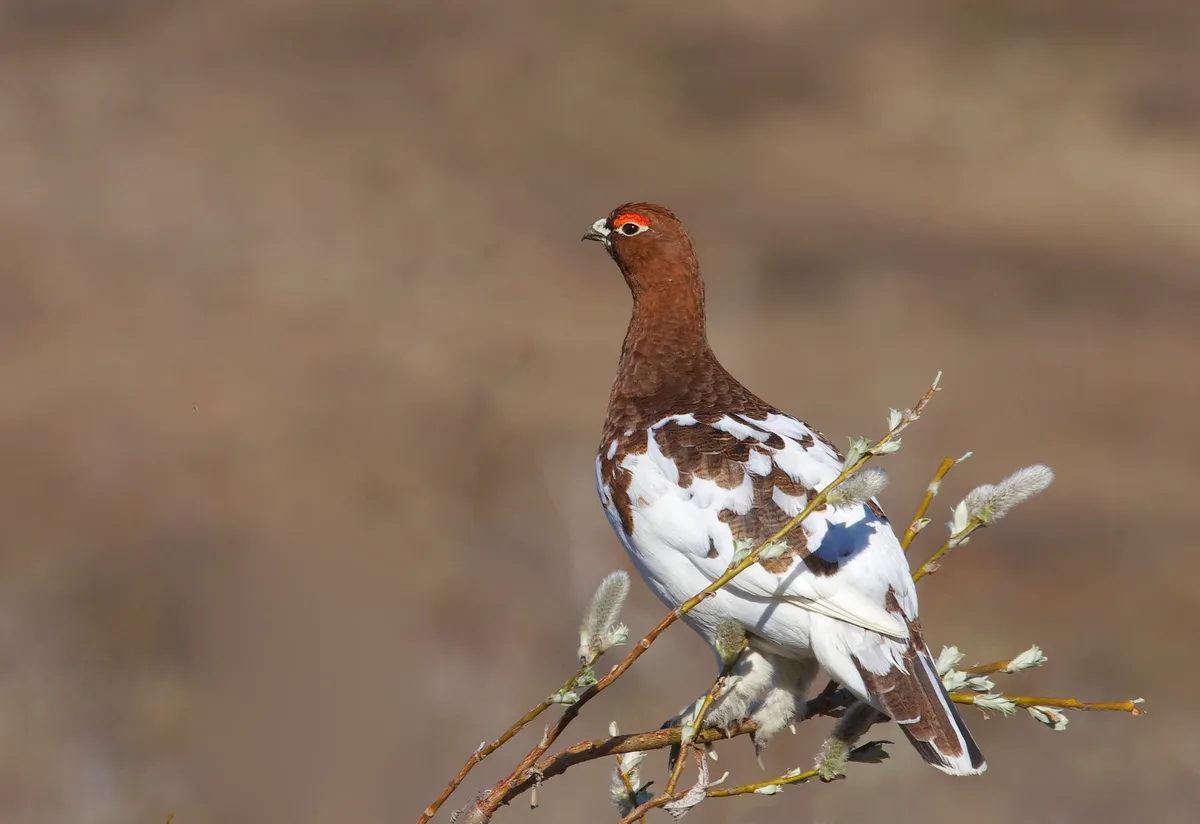
Lagopède des saules— species and hunting in Quebec
Lagopus lagopus
PhasianidaeHunting periods published by Québec.ca
Official tables below — zones, gear and dates.
Wikipedia
Lagopède des saules
The willow ptarmigan ( TAR-mi-gən; Lagopus lagopus) is a bird in the grouse tribe Tetraonini of the pheasant family Phasianidae. It is also known as the willow grouse. The willow ptarmigan breeds in birch and other forests and moorlands in northern Europe, the tundra of Scandinavia, Siberia, Alaska, and Canada, in particular in the provinces of Newfoundland and Labrador and Quebec. It is the state bird of Alaska. In the summer, the birds are largely brown, with dappled plumage, while in the winter, they are white with some black feathers in their tails. The species has remained little changed from the bird that roamed the tundra during the Pleistocene. Nesting takes place in the spring when clutches of four to 10 eggs are laid in a scrape on the ground. The chicks are precocial, so soon leave the nest. While they are young, both parents play a part in caring for them. The chicks eat insects and young plant growth, while the adults are completely herbivorous, eating leaves, flowers, buds, seeds, and berries during the summer and largely subsisting on the buds and twigs of willow and other dwarf shrubs and trees during the winter.
Description
The willow ptarmigan is a medium to large, ground-dwelling bird and is the most numerous of the three species of ptarmigan. Males and females are about the same size, with the adult length varying between 35 and 44 cm (14 and 17 in) with a wingspan ranging from 60 to 65 cm (24 to 26 in). Its weight is 430 to 810 g (15 to 29 oz). It is deep-chested and has a fairly long neck, a broad bill, short, feathered legs, and a moderately short, rounded tail. In the summer, the male's plumage is marbled brown, with a reddish hue to the neck and breast, a black tail, and white wings and underparts. It has red, semicircular combs above the eyes, which become red and prominent in the breeding season. The female is similar in appearance, but with much smaller eye combs and has brown feathers scattered among the white feathers on her belly. During winter, the body plumage and two central tail feathers of both sexes becomes completely white, except for the black outer rectrices. Their wing feathers remain white all year round. Immature birds resemble the adults. The willow ptarmigan can be distinguished from the closely related rock ptarmigan (L. muta) by its larger size and thicker bill and because it is not generally found above the tree line, while the rock ptarmigan prefers more elevated, barren habitat. The summer plumage is browner, and in the winter, the male willow ptarmigan lacks the rock ptarmigan's black stripe between the eyes and bill. The white-tailed ptarmigan (L. leucura) in North America is smaller, has a white tail and finely-barred greyer plumage, and lives permanently above the tree line. The distinctive red grouse of the British Isles was once considered to be a subspecies. This moorland bird is reddish brown all over, except for its white feet.
Text from Wikipedia — Willow ptarmigan, revision 1367782720, CC BY-SA 4.0, retrieved 2026-09-04. Encyclopedic text reused under CC BY-SA 4.0. Sentences about hunting or regulation are removed: on this site, the rule comes from Québec.ca.
Other names
English
Presence in Quebec
- Origin
- Indigène
- Occurrence
- Régulier
- Population status
- Toute l'année
- Certainty
- Confirmé
Conservation
Québec.ca
Official periods
Source: Québec.ca — tables reproduced as published (retrieved 2026-08-30).
Hunting
Rock ptarmigan and willow ptarmigan
| Zone where hunting is permitted | Gear | 2026-2027 hunting season | 2027-2028 hunting season |
|---|---|---|---|
| 1, 2, 3, 4, 5, 6, 7, 8, 9, 10, 11, 12, 13, 14, 15, 16, 17, 18, 20, 21, 26, 27, 28 | Firearms, air rifles, crossbow and bow The use of a crossbow is prohibited in zone 17. | From September 19, 2026 to March 31, 2027 | From September 18, 2027 to March 31, 2028 |
| 19 South, 29 | Firearms, air rifles, crossbow and bow | From September 12, 2026 to March 31, 2027 | From September 11, 2027 to March 31, 2028 |
| 22, 23, 24 | Firearms, air rifles and bow | From September 12, 2026 to April 30, 2027 | From September 11, 2027 to April 30, 2028 |
Zones where hunting is permitted
Zone numbers listed in the tables above. Each links to the official zone map (PDF).
Regulations change. Always check Québec.ca before hunting or trapping.
SIT Québec register
Outfitters hunting this species
24 outfitters list this species among the game they hunt.
Where this data comes from
This species is listed in an official government dataset. The identification and status shown in the data sheet are reproduced from it.
Source: List of Quebec’s vertebrate wildlife (LFVQ) — Ministère de l’Environnement, de la Lutte contre les changements climatiques, de la Faune et des Parcs. File LFVQ_25_03_2026.csv, retrieved 2026-08-30 · CC BY 4.0.
Measurements, habitat, diet and reproduction are not shown: no official source is attached to them yet.