
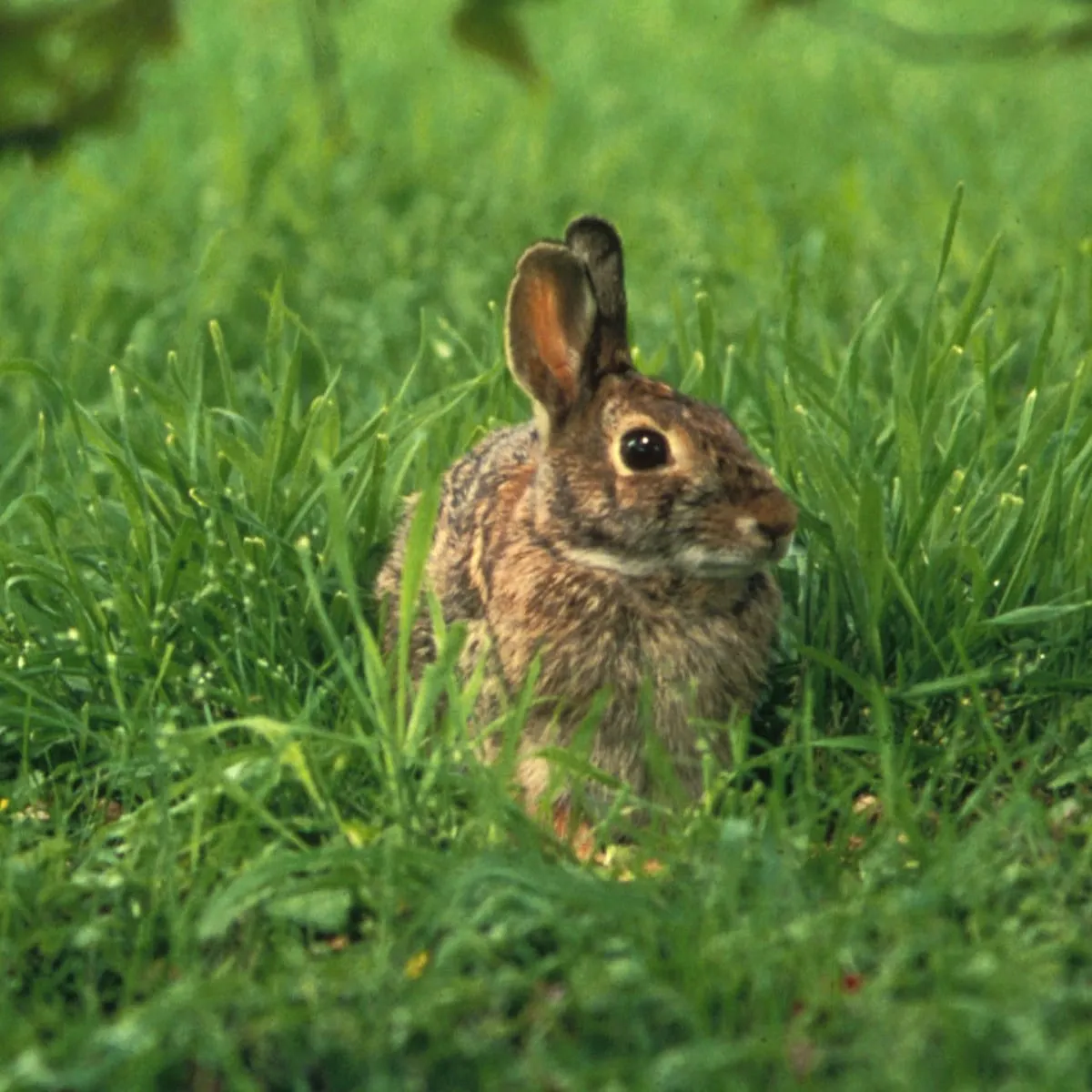
Lapin à queue blanche— species and hunting in Quebec
Sylvilagus floridanus
LeporidaeHunting periods published by Québec.ca
Official tables below — zones, gear and dates.
Wikipedia
Lapin à queue blanche
The eastern cottontail (Sylvilagus floridanus) is a species of rabbit in the family Leporidae. It is the most widespread and abundant rabbit species in North America, inhabiting a wide range that extends from southern Canada throughout most of the United States and into parts of Mexico, Central America, and the northern regions of South America. Known for its distinctive fluffy white tail, which resembles a cotton ball and gives the species its common name, the eastern cottontail typically inhabits open fields, meadows, and brushy areas where it can easily find cover and food. It is a primarily herbivorous, crepuscular mammal that feeds on grasses, herbs, twigs, and bark, and plays an important role in the ecosystem as prey for a variety of predators including foxes, hawks, and owls. Due to its adaptability to human-altered landscapes such as suburban and agricultural areas, the eastern cottontail has maintained stable population levels and is not considered threatened. It is also well known for its high reproductive rate, with females capable of producing multiple large litters annually, which contributes to its widespread presence.
Description
The eastern cottontail has a distinctive white spot on its forehead when young and fur that ranges from reddish-brown to grayish-brown, with large hind feet, long ears, and a short, fluffy white tail. Its underside is white, and there is a rusty patch near the tail. It differs from a hare in its overall smaller size and brownish-gray coloring around the head and neck, with a lighter-colored body and a white underside on the tail. The species also has large brown eyes and long ears adapted for detecting predators. During winter, the eastern cottontail's pelage becomes more gray than brown. Kits (young rabbits) develop a similar coloring after a few weeks but are born with a white blaze running down their forehead, which fades as they mature. This rabbit is medium-sized, measuring 36–48 cm (14–19 in) in total length, including a tail that averages 5.3 cm (2.1 in). Adults typically weigh between 1.8 and 4.4 lb (800 and 2,000 g), with an average of around 2.6 lb (1,200 g). Females tend to be slightly heavier than males, although the sexes broadly overlap in size. The species exhibits slight geographic variation in body size, with individuals generally increasing in mass from southern to northern latitudes, in line with Bergmann's rule. For example, adult specimens from the Florida Museum of Natural History have a mean weight of 2.24 lb (1.018 kg), whereas a study of 346 adults from Michigan found an average mass of 3.19 lb (1.445 kg).
Text from Wikipedia — Eastern cottontail, revision 1371889828, CC BY-SA 4.0, retrieved 2026-09-04. Encyclopedic text reused under CC BY-SA 4.0. Sentences about hunting or regulation are removed: on this site, the rule comes from Québec.ca.
Presence in Quebec
- Origin
- Indigène
- Occurrence
- Régulier
- Population status
- Toute l'année
- Certainty
- Confirmé
Conservation
Québec.ca
Official periods
Source: Québec.ca — tables reproduced as published (retrieved 2026-08-30).
Hunting
Eastern cottontail, Arctic hare and snowshoe hare
| Zone where hunting is permitted | Gear | 2026-2027 hunting season | 2027-2028 hunting season |
|---|---|---|---|
| 1, 2, 3, 4, 5, 6, 7, 8, 9, 10, 11, 12, 13, 14, 15, 16, 17, 18, 20, 21 (except the Îles-de-la-Madeleine), 26, 27, 28 | Firearms, air rifles, crossbow and bow The use of a crossbow is prohibited in zone 17. | From September 19, 2026 to March 31, 2027 | From September 18, 2027 to March 31, 2028 |
| 19 South, 29 | Firearms, air rifles, crossbow and bow | From September 12, 2026 to March 31, 2027 | From September 11, 2027 to March 31, 2028 |
| 22, 23, 24 | Firearms, air rifles, crossbow and bow | From September 12, 2026 to April 30, 2027 | From September 11, 2027 to April 30, 2028 |
| Île-du-Havre-Aubert | Firearms, air rifles and bow | From November 14 to December 6, 2026 | From November 20 to December 12, 2027 |
| 1, 2, 3, 4, 5, 6, 7, 9, 10, 11, 12, 13, 14, 15, 16, 17, 18, 20, 21 (except the Îles-de-la-Madeleine), 26, 27 (except Île d’Orléans), 28 | Snare In zone 17, the use of snares to harvest snowshoe hare is permitted only in non-Indigenous establishments and in the vicinity of those establishments. | From September 19, 2026 to March 31, 2027 | From September 18, 2027 to March 31, 2028 |
| 19 South, 29 | Snare | From September 12, 2026 to March 31, 2027 | From September 11, 2027 to March 31, 2028 |
Zones where hunting is permitted
Zone numbers listed in the tables above. Each links to the official zone map (PDF).
Regulations change. Always check Québec.ca before hunting or trapping.
Where this data comes from
This species is listed in an official government dataset. The identification and status shown in the data sheet are reproduced from it.
Source: List of Quebec’s vertebrate wildlife (LFVQ) — Ministère de l’Environnement, de la Lutte contre les changements climatiques, de la Faune et des Parcs. File LFVQ_25_03_2026.csv, retrieved 2026-08-30 · CC BY 4.0.
Measurements, habitat, diet and reproduction are not shown: no official source is attached to them yet.