
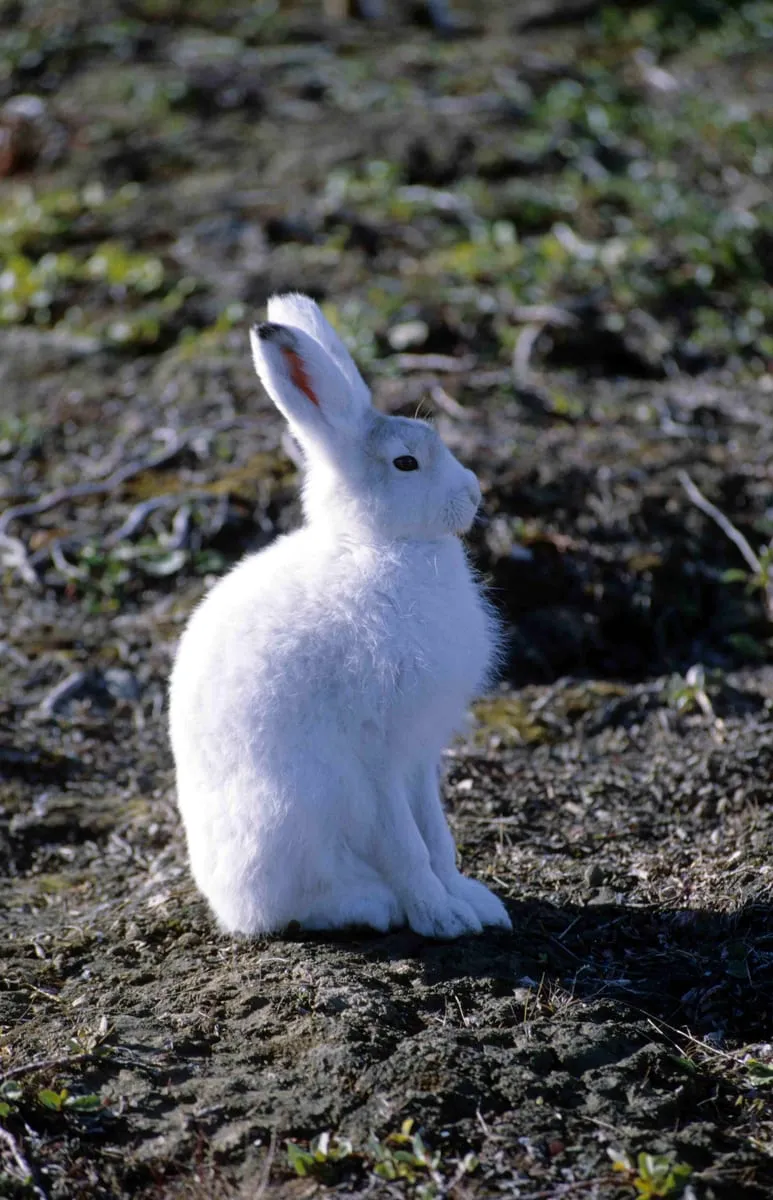
Lièvre arctique— species and hunting in Quebec
Lepus arcticus
LeporidaeHunting periods published by Québec.ca
Official tables below — zones, gear and dates.
Wikipedia
Lièvre arctique
The Arctic hare (Lepus arcticus) is a species of hare highly adapted to living in the Arctic tundra and other icy biomes. The Arctic hare survives with shortened ears and limbs, a small nose, fat that makes up close to 20% of its body, and a thick coat of fur. It usually digs holes in the ground or under the snow to keep warm and to sleep. Arctic hares look like rabbits but have shorter ears, are taller when standing, and, unlike rabbits, can thrive in extreme cold. They can travel together with many other hares, sometimes huddling with dozens or more, but are usually found alone, sometimes taking more than one partner. The Arctic hare can run up to 60 kilometres per hour (40 mph).
Description
The Arctic hare is one of the largest living lagomorphs. Typically, this species measures from 43 to 70 cm (17 to 28 in) long, not counting a tail length of 4.5 to 10 cm (1.8 to 3.9 in). The body mass of this species is typically between 2.5–5.5 kg (6–12 lb), though large individuals can weigh up to 7 kg (15 lb).
Diet
The Arctic hare is a herbivore, specifically a folivore. Arctic hares feed primarily on woody plants, with arctic willow constituting 95% of their diet year-round. Arctic hares predominantly consume saxifrage, crowberry, and dwarf willow, but can also eat a variety of other foods, including lichens and mosses, blooms, other species' leaves, twigs, and roots, mountain sorrel and macroalgae (seaweed). Arctic hare diets are more diverse in summer. Although previously believed to still be primarily willow, dryas, and grasses, recent studies show that their diet becomes dominated by legumes, constituting 70% of their diet in the summer. Arctic hares have been reported to occasionally eat meat, including fish and the stomach contents of eviscerated caribou. They eat snow to get water.
Text from Wikipedia — Arctic hare, revision 1356897280, CC BY-SA 4.0, retrieved 2026-09-04. Encyclopedic text reused under CC BY-SA 4.0. Sentences about hunting or regulation are removed: on this site, the rule comes from Québec.ca.
Presence in Quebec
- Origin
- Indigène
- Occurrence
- Régulier
- Population status
- Toute l'année
- Certainty
- Confirmé
Conservation
Québec.ca
Official periods
Source: Québec.ca — tables reproduced as published (retrieved 2026-08-30).
Hunting
Eastern cottontail, Arctic hare and snowshoe hare
| Zone where hunting is permitted | Gear | 2026-2027 hunting season | 2027-2028 hunting season |
|---|---|---|---|
| 1, 2, 3, 4, 5, 6, 7, 8, 9, 10, 11, 12, 13, 14, 15, 16, 17, 18, 20, 21 (except the Îles-de-la-Madeleine), 26, 27, 28 | Firearms, air rifles, crossbow and bow The use of a crossbow is prohibited in zone 17. | From September 19, 2026 to March 31, 2027 | From September 18, 2027 to March 31, 2028 |
| 19 South, 29 | Firearms, air rifles, crossbow and bow | From September 12, 2026 to March 31, 2027 | From September 11, 2027 to March 31, 2028 |
| 22, 23, 24 | Firearms, air rifles, crossbow and bow | From September 12, 2026 to April 30, 2027 | From September 11, 2027 to April 30, 2028 |
| Île-du-Havre-Aubert | Firearms, air rifles and bow | From November 14 to December 6, 2026 | From November 20 to December 12, 2027 |
| 1, 2, 3, 4, 5, 6, 7, 9, 10, 11, 12, 13, 14, 15, 16, 17, 18, 20, 21 (except the Îles-de-la-Madeleine), 26, 27 (except Île d’Orléans), 28 | Snare In zone 17, the use of snares to harvest snowshoe hare is permitted only in non-Indigenous establishments and in the vicinity of those establishments. | From September 19, 2026 to March 31, 2027 | From September 18, 2027 to March 31, 2028 |
| 19 South, 29 | Snare | From September 12, 2026 to March 31, 2027 | From September 11, 2027 to March 31, 2028 |
Zones where hunting is permitted
Zone numbers listed in the tables above. Each links to the official zone map (PDF).
Regulations change. Always check Québec.ca before hunting or trapping.
Where this data comes from
This species is listed in an official government dataset. The identification and status shown in the data sheet are reproduced from it.
Source: List of Quebec’s vertebrate wildlife (LFVQ) — Ministère de l’Environnement, de la Lutte contre les changements climatiques, de la Faune et des Parcs. File LFVQ_25_03_2026.csv, retrieved 2026-08-30 · CC BY 4.0.
Measurements, habitat, diet and reproduction are not shown: no official source is attached to them yet.