
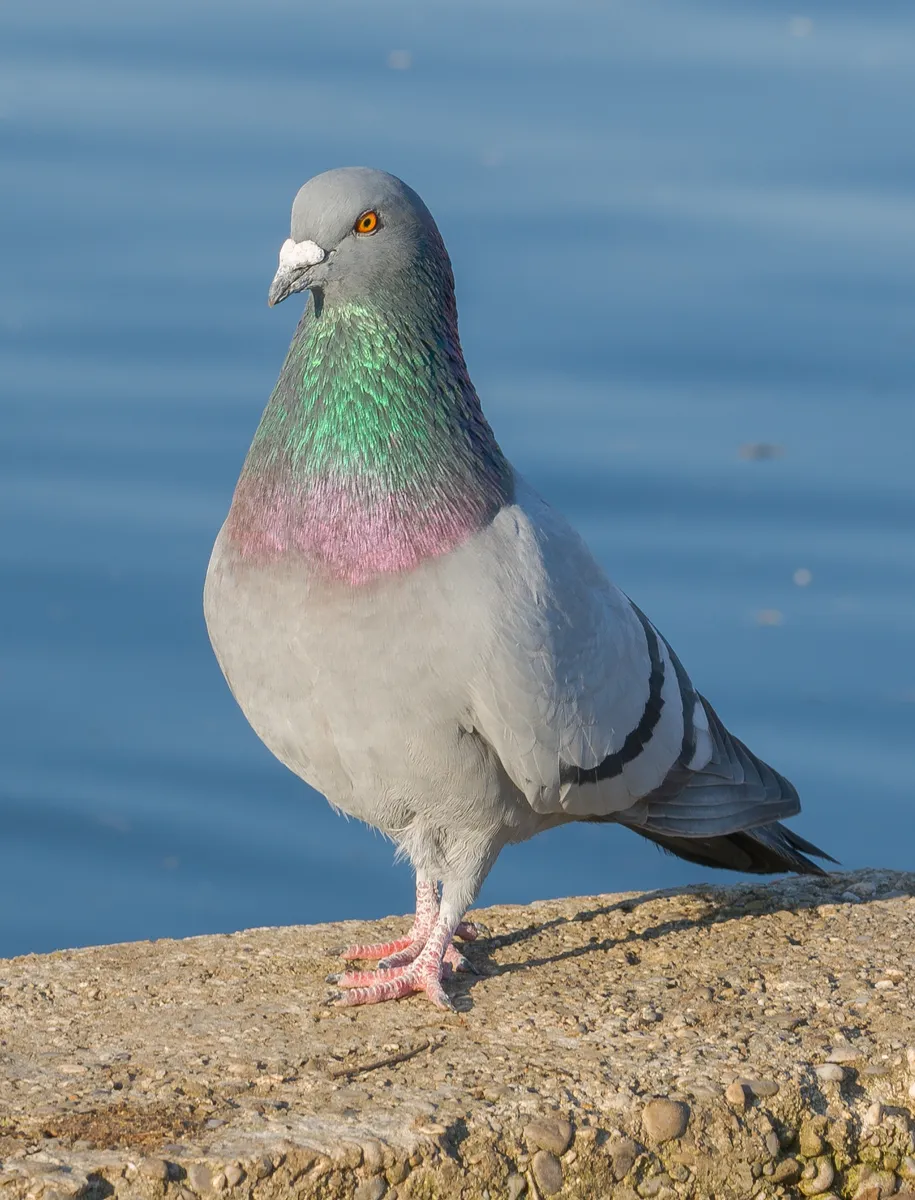
Pigeon biset— species and hunting in Quebec
Columba livia
ColumbidaeHunting periods published by Québec.ca
Official tables below — zones, gear and dates.
Wikipedia
Pigeon biset
The rock dove (Columba livia), also known as the common pigeon or rock pigeon (but see also Petrophassa), is a member of the bird family Columbidae (doves and pigeons). In common usage, it is often simply referred to as the "pigeon", although the rock dove is the wild form of the bird; the pigeons familiar to most people are the domesticated forms of the wild rock dove. Wild rock doves are uniformly pale grey with two black bars on each wing, with few differences being seen between males and females; i.e. they are not strongly sexually dimorphic. The domestic pigeon, often called "Columba livia domestica", which includes about 1,000 different breeds, is descended from this species. Escaped domestic pigeons are the origin of feral pigeons around the world. Both forms can vary widely in the colour and pattern of their plumage unlike their wild ancestor, being red, brown, checkered, uniformly coloured, or pied. Habitats include various open and semi-open environments where they are able to forage on the ground. Cliffs and rock ledges are used for roosting and breeding in the wild. Originating in Southern Europe, North Africa, and Western Asia, when including their domestic and feral descendants, they are an example of a least-concern species per IUCN among birds, being abundant with an estimated population of 17 to 28 million wild and feral birds in Europe alone and up to 120 million worldwide.
Description
Millennia of domestication have greatly altered the rock dove in many regions. Domestic and Feral pigeons, which arose through selective breeding, not originating naturally, have significant variation in plumage from the natural wild birds. This wild type is endangered in many areas; the nominate subspecies C. l. livia persists most notably in the far north and west of Scotland, most strongly so in the Outer Hebrides. The adult of the nominate subspecies of the rock dove is 30 to 35 cm (12 to 14 in) long with a 62 to 68 cm (24 to 27 in) wingspan. Weight for wild or feral rock doves ranges from 238–380 g (8.4–13.4 oz), though overfed domestic and semi-domestic individuals can exceed normal weights. For standard measurements, the wing chord is typically around 22.3 cm (8.8 in), the tail is 9.5 to 11 cm (3.7 to 4.3 in), the bill is around 1.8 cm (0.71 in), and the tarsus is 2.6 to 3.5 cm (1.0 to 1.4 in). This species has dark bluish-grey head, neck, and chest feathers with glossy greenish to reddish-purple iridescence along its neck feathers. The white lower back of the pure rock dove is its best identification characteristic; the two black bars on its pale grey wings are also distinctive. The tail has a black band on the end, and the outer web of the tail feathers are margined with white. The iris is red-brown. The eyelids are grey with a very narrow bluish-grey to grey-white eye ring (wider in domesticated and feral birds). The bill is grey-black with a small off-white cere (with domesticated and feral birds having a much larger cere).
Text from Wikipedia — Rock dove, revision 1372550152, CC BY-SA 4.0, retrieved 2026-09-04. Encyclopedic text reused under CC BY-SA 4.0. Sentences about hunting or regulation are removed: on this site, the rule comes from Québec.ca.
Other names
French
English
Presence in Quebec
- Origin
- Exotique
- Occurrence
- Régulier
- Population status
- Toute l'année
- Certainty
- Confirmé
Conservation
Québec.ca
Official periods
Source: Québec.ca — tables reproduced as published (retrieved 2026-08-30).
Hunting
Training and competition activities for hunting dogs, using quail, northern bobwhite, pheasant, francolin, rock partridge, chukar partridge, red-legged partridge, rock dove, and guinea fowl
| Zone where hunting is permitted | Gear | 2026-2027 hunting season | 2027-2028 hunting season |
|---|---|---|---|
| 1, 2, 3, 4, 5, 6, 7, 8, 9, 10, 11, 12, 13, 14, 15, 16, 17, 18, 19 South, 21, 22, 23, 24, 26, 27, 28, 29 | Firearms, air rifles, crossbow and bow The use of a crossbow is prohibited in zones 17, 22, 23 and 24. | All year | All year |
Hunting
Rock dove
| Zone where hunting is permitted | Gear | 2026-2027 hunting season | 2027-2028 hunting season |
|---|---|---|---|
| 1, 2 (except île Verte), 3, 4, 5, 6, 7, 8, 9, 10, 11, 12, 13, 14, 15, 16, 17, 18, 19 South, 20, 21, 22, 23, 24, 26, 27, 28, 29 | Firearms, air rifles, crossbow and bow The use of a crossbow is prohibited in zones 17, 22, 23 and 24. | All year | All year |
Zones where hunting is permitted
Zone numbers listed in the tables above. Each links to the official zone map (PDF).
Regulations change. Always check Québec.ca before hunting or trapping.
Where this data comes from
This species is listed in an official government dataset. The identification and status shown in the data sheet are reproduced from it.
Source: List of Quebec’s vertebrate wildlife (LFVQ) — Ministère de l’Environnement, de la Lutte contre les changements climatiques, de la Faune et des Parcs. File LFVQ_25_03_2026.csv, retrieved 2026-08-30 · CC BY 4.0.
Measurements, habitat, diet and reproduction are not shown: no official source is attached to them yet.