
Hunting periods published by Québec.ca
Official tables below — zones, gear and dates.
Wikipedia
Quiscale bronzé
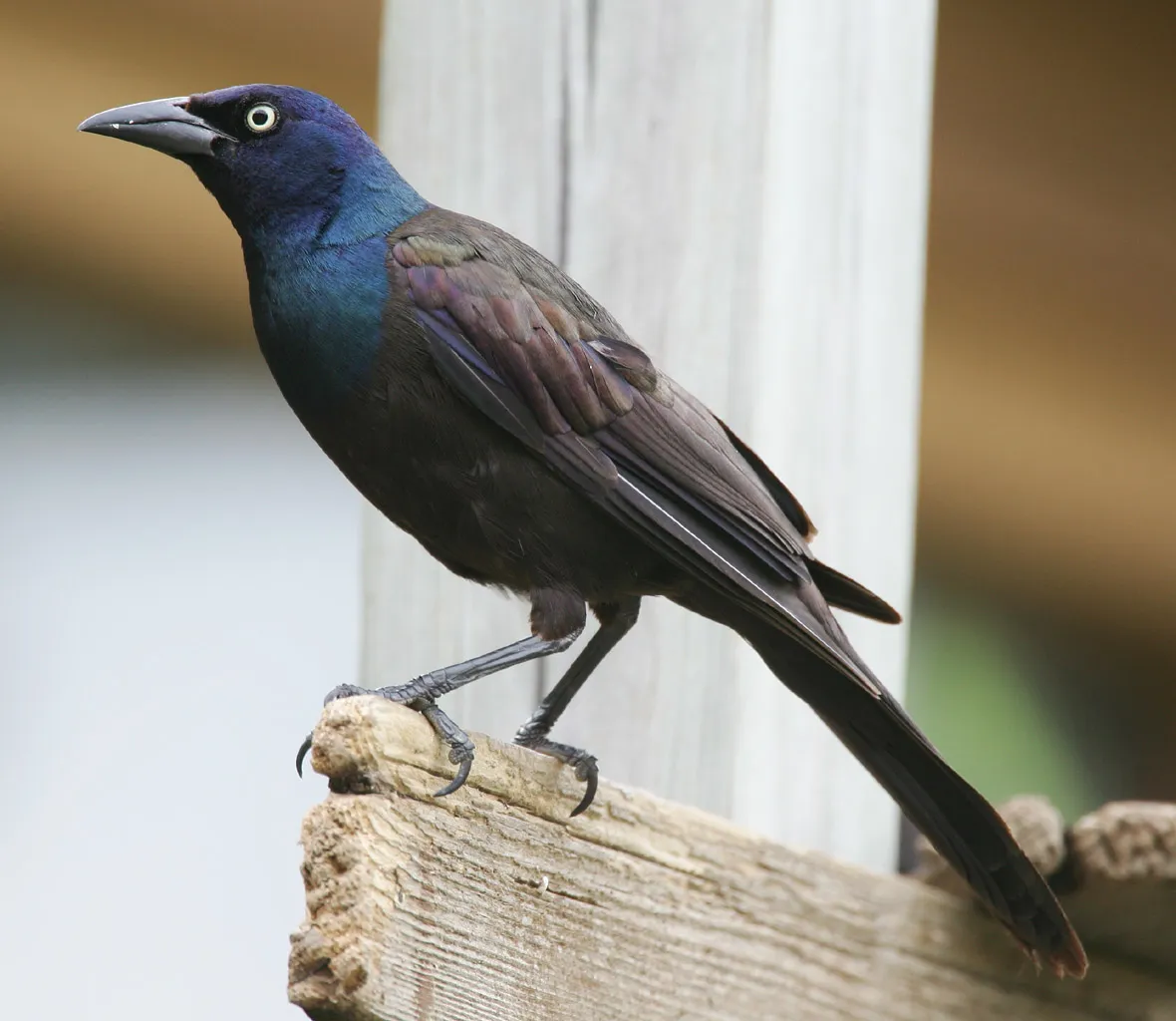
The common grackle (Quiscalus quiscula) is an icterid bird found in large numbers through much of North America. It was first described in 1758 by Carl Linnaeus and has three officially recognized subspecies. Adult common grackles have a long and dark bill, pale yellow eyes, and a long tail. Adults often have a bluish iridescent appearance on their head, this feature being more pronounced on males. Common grackles can be found widely across North America east of the Rocky Mountains and are highly adaptable to their environment.
Description
Adult common grackles measure from 28 to 34 cm (11 to 13 in) in length, span 36–46 cm (14–18 in) across the wings, and weigh 74–142 g (2.6–5.0 oz). Common grackles are less sexually dimorphic than larger grackle species, but the differences between the sexes can still be noticeable. The male, which averages 122 g (4.3 oz), is larger than the female, at an average of 94 g (3.3 oz). Adults have a long, dark bill, pale yellowish eyes, and a long tail; their feathers appear black with purple, green, or blue iridescence on the head, and primarily bronze sheen in the body plumage. Adult females, beyond being smaller, are usually less iridescent; their tails in particular are shorter, and unlike the males, do not keel (display a longitudinal ridge) in flight and are brown with no purple or blue gloss. Juveniles are brown with dark brown eyes. When grackles are in a group, they are referred to as a "plague".
Text from Wikipedia — Common grackle, revision 1372833655, CC BY-SA 4.0, retrieved 2026-09-04. Encyclopedic text reused under CC BY-SA 4.0. Sentences about hunting or regulation are removed: on this site, the rule comes from Québec.ca.
Other names
French
English
Presence in Quebec
- Origin
- Indigène
- Occurrence
- Régulier
- Population status
- Reproducteur
- Certainty
- Confirmé
Conservation
Québec.ca
Official periods
Source: Québec.ca — tables reproduced as published (retrieved 2026-08-30).
Hunting
Red-winged blackbird, American crow, European starling, house sparrow, common grackle, brown-headed cowbird
| Zone where hunting is permitted | Gear | 2026-2027 hunting season | 2027-2028 hunting season |
|---|---|---|---|
| 1, 2, 3, 4, 5, 6, 7, 8, 9, 10, 11, 12, 13, 14, 15, 16, 17, 18,19 South, 20, 21, 22, 23, 24, 26, 27, 28, 29 | Firearms, air rifles, crossbow and bow The use of a crossbow is prohibited in zones 17, 22, 23 and 24. | July 1, 2026 to April 30, 2027 | July 1, 2027 to April 30, 2028 |
Zones where hunting is permitted
Zone numbers listed in the tables above. Each links to the official zone map (PDF).
Regulations change. Always check Québec.ca before hunting or trapping.
Where this data comes from
This species is listed in an official government dataset. The identification and status shown in the data sheet are reproduced from it.
Source: List of Quebec’s vertebrate wildlife (LFVQ) — Ministère de l’Environnement, de la Lutte contre les changements climatiques, de la Faune et des Parcs. File LFVQ_25_03_2026.csv, retrieved 2026-08-30 · CC BY 4.0.
Measurements, habitat, diet and reproduction are not shown: no official source is attached to them yet.