
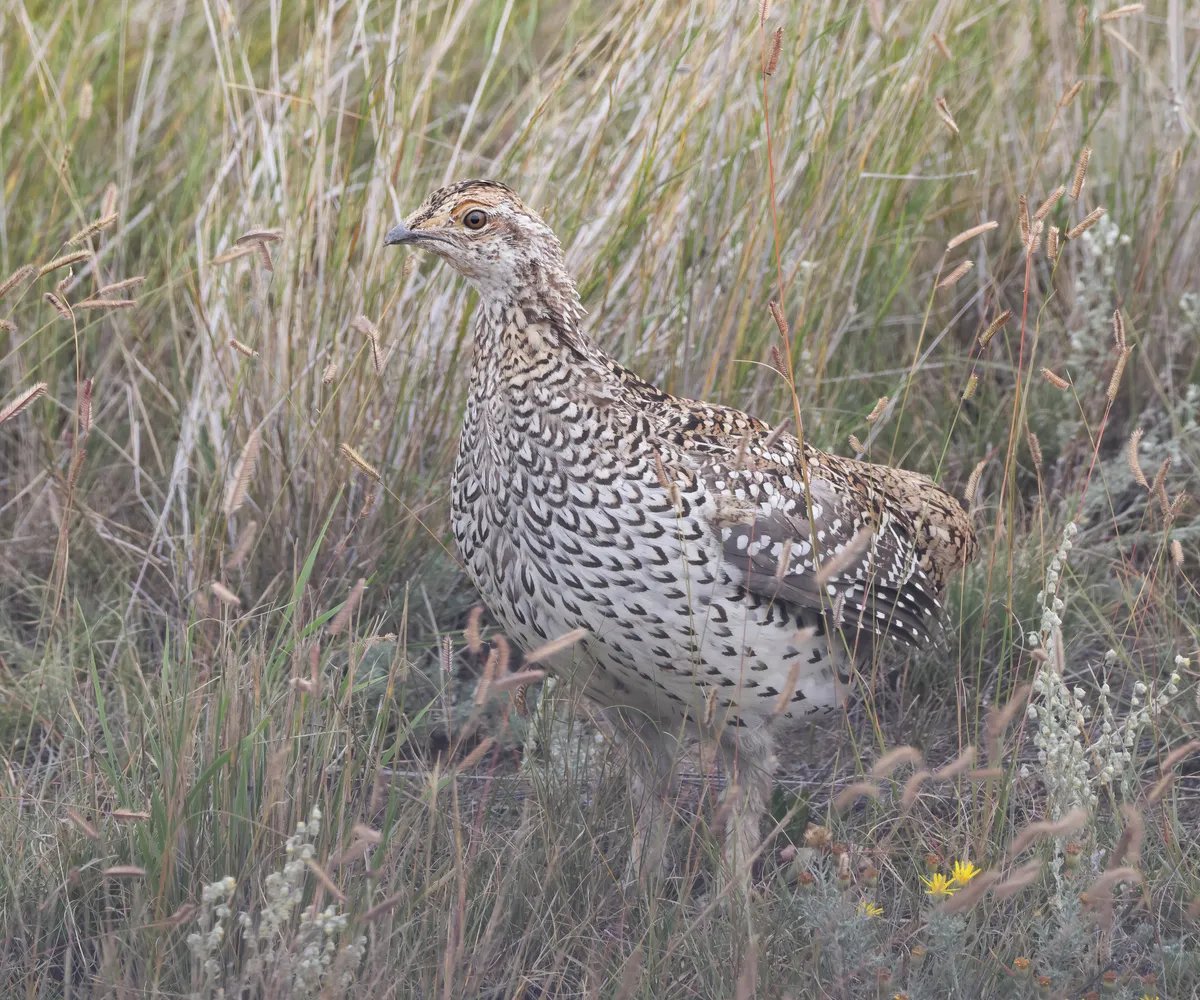
Tétras à queue fine— species and hunting in Quebec
Tympanuchus phasianellus
PhasianidaeHunting periods published by Québec.ca
Official tables below — zones, gear and dates.
Wikipedia
Tétras à queue fine
The sharp-tailed grouse (Tympanuchus phasianellus), also known as the sharptail or fire grouse, is a medium-sized prairie grouse. One of three species in the genus Tympanuchus, the sharp-tailed grouse is found throughout Alaska, much of Northern and Western Canada, and parts of the Western and Midwestern United States. The sharp-tailed grouse is the provincial bird of the Canadian province of Saskatchewan.
Description
Adults have a relatively short tail with the two central (deck) feathers being square-tipped and somewhat longer than their lighter, outer tail feathers giving the bird its distinctive name. The plumage is mottled dark and light browns against a white background, they are lighter on the underparts with a white belly uniformly covered in faint V-shaped markings. These markings distinguish sharp-tailed grouse from lesser and greater prairie chickens which are heavily barred on their underparts. Adult males have a yellow comb over their eyes and a violet display patch on their neck. This display patch is another distinguishing characteristic from prairie chickens as male prairie chickens have yellow or orange colored air sacs. The female is smaller than the male and can be distinguished by the regular horizontal markings across the deck feathers as opposed to the irregular markings on the males deck feathers which run parallel to the feather shaft. Females also tend to have less obvious combs. Measurements: Length: 15.0–19.0 in (38.1–48.3 cm) Weight: 21.0–31.0 oz (596–880 g) Wingspan: 24.4–25.6 in (62–65 cm)
Habitat and range
Sharp-tailed grouse historically occupied eight Canadian provinces and 21 U.S. states pre-European settlement. They ranged from as far north as Alaska, south to California and New Mexico, and east to Quebec, Canada. Following European settlement the sharp-tailed grouse has been extirpated from California, Kansas, Illinois, Iowa, Nevada, and New Mexico.
Text from Wikipedia — Sharp-tailed grouse, revision 1366453628, CC BY-SA 4.0, retrieved 2026-09-04. Encyclopedic text reused under CC BY-SA 4.0. Sentences about hunting or regulation are removed: on this site, the rule comes from Québec.ca.
Other names
French
English
Presence in Quebec
- Origin
- Indigène
- Occurrence
- Régulier
- Population status
- Toute l'année
- Certainty
- Confirmé
Conservation
Québec.ca
Official periods
Source: Québec.ca — tables reproduced as published (retrieved 2026-08-30).
Hunting
Ruffed grouse, spruce grouse and sharp-tailed grouse
| Zone where hunting is permitted | Gear | 2026-2027 hunting season | 2027-2028 hunting season |
|---|---|---|---|
| 1, 2 (except Île Verte), 3, 4, 5, 6, 7, 8, 9, 10, 11, 12, 13, 14, 15, 16, 17, 18, 20, 21, 26, 27, 28 | Firearms, air rifles, crossbow and bow The use of a crossbow is prohibited in zone 17. | From September 19, 2026 to January 15, 2027 | From September 18, 2027 to January 15, 2028 |
| 19 South, 22, 23, 24, 29 | Firearms, air rifles, crossbow and bow. The use of a crossbow is prohibited in zones 22, 23 and 24. | From September 12, 2026 to January 15, 2027 | From September 11, 2027 to January 15, 2028 |
Zones where hunting is permitted
Zone numbers listed in the tables above. Each links to the official zone map (PDF).
Regulations change. Always check Québec.ca before hunting or trapping.
Where this data comes from
This species is listed in an official government dataset. The identification and status shown in the data sheet are reproduced from it.
Source: List of Quebec’s vertebrate wildlife (LFVQ) — Ministère de l’Environnement, de la Lutte contre les changements climatiques, de la Faune et des Parcs. File LFVQ_25_03_2026.csv, retrieved 2026-08-30 · CC BY 4.0.
Measurements, habitat, diet and reproduction are not shown: no official source is attached to them yet.