
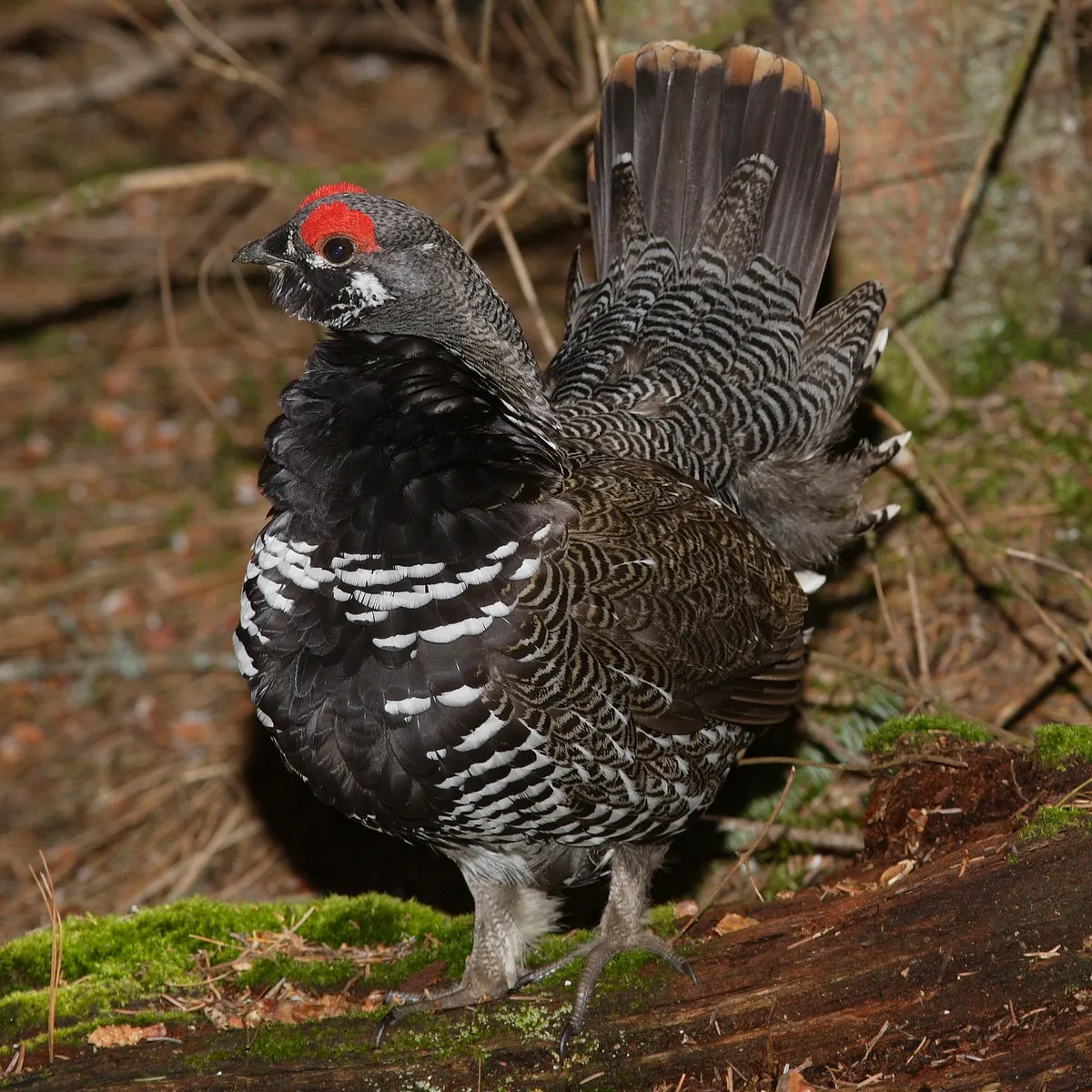
Tétras du Canada— species and hunting in Quebec
Canachites canadensis
PhasianidaeHunting periods published by Québec.ca
Official tables below — zones, gear and dates.
Wikipedia
Tétras du Canada
The spruce grouse (Canachites canadensis), also known as Canada grouse, spruce hen or fool hen, is a medium-sized grouse closely associated with the coniferous boreal forests or taiga of North America. It is the only member of the genus Canachites. It is one of the most arboreal grouse species, fairly well adapted to perching and moving about in trees. When approached by a predator, it relies on camouflage and immobility to an amazing degree; for example, letting people approach within a few feet before finally taking flight.
Description
Spruce grouse are 38–43 cm (15–17 in) long; males weigh 550–650 g (19–23 oz) and females 450–550 g (16–19 oz). The spruce grouse has a wingspan range of 21.5–22.6 in (55–57 cm). Races vary slightly in plumage, especially in the tail pattern and in the extent of white on the underparts, but in general adult males are mainly grey above and black below, with white spots along the side, and a red patch of bare skin over the eye called the "eyebrow comb". This red eyebrow comb, should not be confused by a similar yellow marking found on other species of grouse including, but not limited to, sharp-tailed and dusky grouse. Adult females are mottled brown (red morph) or mottled grey (grey morph) with dark and white bars on the underparts. Juveniles resemble females. Females may be confused with ruffed grouse but they have a dark tail with a pale band at the end (while the reverse is true in ruffed grouse) and they do not erect their crown feathers when alarmed the way ruffed grouse do. Spruce grouse are among the most silent of all grouse, but they nevertheless have a number of calls used to warn of predators, to repel territorial intruders, to maintain brood cohesion, or to elicit brooding. In the subspecies franklinii, territorial males are notable for their wing-clap display. At the end of a short flight through the trees, the wings are brought together over the back so as to produce two sharp claps, about half a second apart, loud enough to be heard by the human ear 150 m (490 ft) away. These territorial displays can sometimes be elicited by similar hand clapping, and can be used to detect male territories and estimate their density. Other non-vocal sounds include soft drumming by territorial males (a sound produced by the beating wings) and a tail-swish and a whoosh produced by the tail feathers in flight.
Reproduction
Males are promiscuous; they disperse and advertise a territory that is visited by females for mating. Females are solely responsible for the rest of the reproductive effort though males have been known to stay with young chicks and seem to aid in keeping the brood together. For a nest, they scratch a depression in the ground in a bush or under a low-lying coniferous branch or fallen tree, away from other females and from the males' territories. The nest is lined with grasses, leaves, and a few feathers. Nesting season is from early May to early July. Up to 10 eggs may be laid, the usual number being 4–7.
Text from Wikipedia — Spruce grouse, revision 1353864742, CC BY-SA 4.0, retrieved 2026-09-04. Encyclopedic text reused under CC BY-SA 4.0. Sentences about hunting or regulation are removed: on this site, the rule comes from Québec.ca.
Other names
French
English
Former scientific names
Presence in Quebec
- Origin
- Indigène
- Occurrence
- Régulier
- Population status
- Toute l'année
- Certainty
- Confirmé
Conservation
Québec.ca
Official periods
Source: Québec.ca — tables reproduced as published (retrieved 2026-08-30).
Hunting
Ruffed grouse, spruce grouse and sharp-tailed grouse
| Zone where hunting is permitted | Gear | 2026-2027 hunting season | 2027-2028 hunting season |
|---|---|---|---|
| 1, 2 (except Île Verte), 3, 4, 5, 6, 7, 8, 9, 10, 11, 12, 13, 14, 15, 16, 17, 18, 20, 21, 26, 27, 28 | Firearms, air rifles, crossbow and bow The use of a crossbow is prohibited in zone 17. | From September 19, 2026 to January 15, 2027 | From September 18, 2027 to January 15, 2028 |
| 19 South, 22, 23, 24, 29 | Firearms, air rifles, crossbow and bow. The use of a crossbow is prohibited in zones 22, 23 and 24. | From September 12, 2026 to January 15, 2027 | From September 11, 2027 to January 15, 2028 |
Zones where hunting is permitted
Zone numbers listed in the tables above. Each links to the official zone map (PDF).
Regulations change. Always check Québec.ca before hunting or trapping.
Where this data comes from
This species is listed in an official government dataset. The identification and status shown in the data sheet are reproduced from it.
Source: List of Quebec’s vertebrate wildlife (LFVQ) — Ministère de l’Environnement, de la Lutte contre les changements climatiques, de la Faune et des Parcs. File LFVQ_25_03_2026.csv, retrieved 2026-08-30 · CC BY 4.0.
Measurements, habitat, diet and reproduction are not shown: no official source is attached to them yet.